Compliance
Axle Weight Limits in Canada: A Quick Reference Guide
A load can be perfectly legal on total weight and still get you fined — or put out of service at a scale — if that weight isn't distributed properly across your axles.
Why axle weight is regulated separately from total weight
Roads and bridges are engineered to handle a certain force per axle, not just a total vehicle weight. The same 40,000 kg spread across six axles puts far less stress on any single point than it does concentrated on two or three. That's why Canadian jurisdictions regulate both numbers independently — and why you can pass a gross weight check and still fail on a single axle group.
How much can you actually load? Payload by axle configuration
The tables below show typical maximum recommended payload — the weight of your freight inside the trailer, including pallets, packaging, and load securing devices. This is the number that matters when you're planning a shipment, because it's already net of tractor and trailer weight.
Two things drive the differences: how many axles the trailer has, and whether you're moving during a thaw period.
2-axle semi-trailer
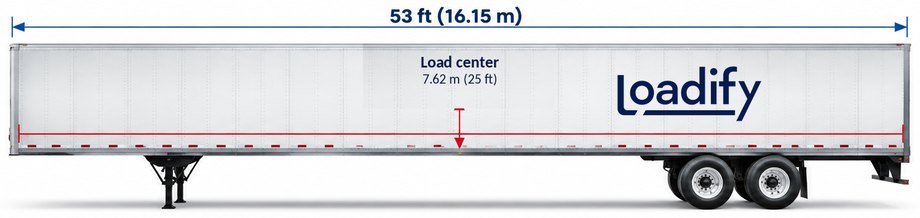
53 ft trailer, load centre 25 ft. Maximum recommended payload inside the trailer.
| Jurisdiction | Dry van | Heated | Reefer | |||
|---|---|---|---|---|---|---|
| Normal | Thaw | Normal | Thaw | Normal | Thaw | |
| Quebec / Ont / Maritimes | 55,000 lb24,948 kg | 46,000 lb20,865 kg | 54,000 lb24,494 kg | 45,000 lb20,412 kg | 52,500 lb23,814 kg | 43,500 lb19,731 kg |
| Intra-Quebec | 55,000 lb24,948 kg | 46,000 lb20,865 kg | 54,000 lb24,494 kg | 45,000 lb20,412 kg | 52,500 lb23,814 kg | 43,500 lb19,731 kg |
| Intra-Ontario | 55,000 lb24,948 kg | 55,000 lb24,948 kg | 54,000 lb24,494 kg | 54,000 lb24,494 kg | 52,500 lb23,814 kg | 52,500 lb23,814 kg |
| USA | 45,000 lb20,412 kg | 45,000 lb20,412 kg | 44,000 lb19,958 kg | 44,000 lb19,958 kg | 42,500 lb19,278 kg | 42,500 lb19,278 kg |
3-axle semi-trailer
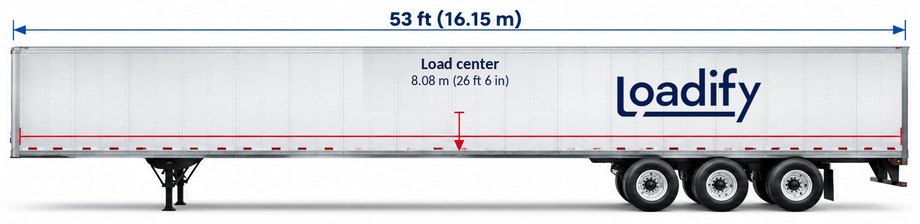
53 ft trailer, load centre 26 ft 6 in. Maximum recommended payload inside the trailer.
| Jurisdiction | Dry van | Heated | Reefer | |||
|---|---|---|---|---|---|---|
| Normal | Thaw | Normal | Thaw | Normal | Thaw | |
| Quebec / Ont / Maritimes | 68,000 lb30,844 kg | 54,000 lb24,494 kg | 67,000 lb30,391 kg | 53,000 lb24,040 kg | 65,500 lb29,710 kg | 51,500 lb23,360 kg |
| Intra-Quebec | 68,000 lb30,844 kg | 54,000 lb24,494 kg | 67,000 lb30,391 kg | 53,000 lb24,040 kg | 65,500 lb29,710 kg | 51,500 lb23,360 kg |
| Intra-Ontario | 68,000 lb30,844 kg | 68,000 lb30,844 kg | 67,000 lb30,391 kg | 67,000 lb30,391 kg | 65,000 lb29,484 kg | 65,000 lb29,484 kg |
4-axle semi-trailer
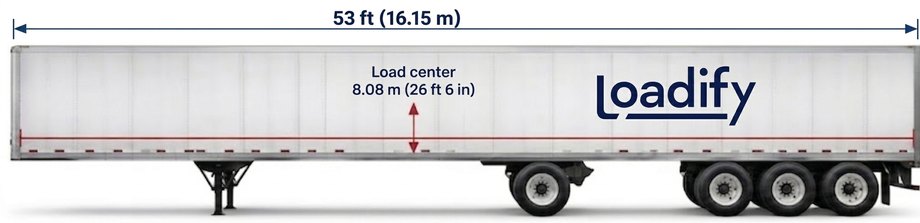
53 ft trailer, load centre 26 ft 6 in. Maximum recommended payload inside the trailer.
| Jurisdiction | Dry van | Heated | Reefer | |||
|---|---|---|---|---|---|---|
| Normal | Thaw | Normal | Thaw | Normal | Thaw | |
| Quebec / Ont / Maritimes | 81,000 lb36,740 kg | 65,500 lb29,710 kg | 80,000 lb36,287 kg | 64,500 lb29,257 kg | 79,000 lb35,834 kg | 63,500 lb28,803 kg |
| Intra-Quebec | 81,000 lb36,740 kg | 65,500 lb29,710 kg | 80,000 lb36,287 kg | 64,500 lb29,257 kg | 79,000 lb35,834 kg | 63,500 lb28,803 kg |
| Intra-Ontario | 81,000 lb36,740 kg | 81,000 lb36,740 kg | 80,000 lb36,287 kg | 80,000 lb36,287 kg | 79,000 lb35,834 kg | 79,000 lb35,834 kg |
| Michigan | 59,000 lb26,761 kg | 59,000 lb26,761 kg | 58,000 lb26,308 kg | 58,000 lb26,308 kg | — | — |
The thaw period is where loads get caught
Look at the difference in those tables. A 3-axle dry van running Quebec to Ontario can carry 68,000 lb in normal conditions — but only 54,000 lb during a thaw period. That's 14,000 lb of capacity that disappears seasonally.
Spring thaw restrictions (sometimes called frost laws or reduced load periods) exist because as frozen ground thaws, the sub-base beneath the road softens and loses its ability to carry weight. Provinces and municipalities impose reduced limits, typically in March through May, with exact dates announced each year and varying by region and road class.
Note the Ontario exception. Intra-Ontario movements show no thaw reduction in these figures, while the same trailer crossing into Quebec or the Maritimes does. Lane matters as much as equipment — a load that's fine inside Ontario may be illegal the moment it crosses a provincial line.
Cross-border adds another layer
US limits are governed by the federal bridge formula and state rules, and they're generally lower than Canadian limits for the same equipment. A 2-axle trailer that carries 55,000 lb in Canada drops to roughly 45,000 lb in the US. Michigan is its own case, with distinct figures for 4-axle configurations.
If you're planning cross-border freight, size the load to the most restrictive jurisdiction on the route, not the origin.
How improper loading causes a violation on a "legal" load
The most common scenario: total weight is under the limit, but the freight is loaded too far forward or too far back. That concentrates weight on the drive axles or the trailer tandems, and one axle group goes over while the gross stays legal.
- Heavy freight loaded nose-first overloads the drives
- Heavy freight at the rear overloads the trailer tandems
- Uneven side-to-side loading can trigger a violation even when the axle group total is fine
- Sliding the tandems redistributes weight between drives and trailer axles — it's the standard fix, but it has limits
Practical tips to avoid axle overweight violations
- Know your equipment's tare weight before you plan the load
- Place the heaviest pieces near the trailer's load centre, not at either end
- Check whether your route crosses into a jurisdiction with lower limits or active thaw restrictions
- Scale the load before you're on the highway, not after
- When in doubt, ask the carrier — they know their equipment and their lanes
Why visualizing the load helps
Axle weight problems are fundamentally a distribution problem, and distribution is hard to reason about in a spreadsheet. Seeing where each pallet sits in the trailer — and what that does to the weight balance — catches issues before the truck is loaded rather than after it's been turned back at a scale.
Plan the load before it ships
Freight Map shows you exactly how your freight sits in the trailer, so you can catch distribution problems early.
Try Freight Map


.svg)